Showing posts with label football. Show all posts

Tuesday, 18 May 2010

Numbers Games

Let’s do some maths. (i.e. Readers of a non-analytical bent stop reading now).

ENGLAND

Football
  • Premier League: 20 teams, each plays each other twice. 10 matches per round, 38 rounds per season, therefore 380 matches per season.
  • FA Cup: 64 teams from the third round (when the Premiership clubs enter). That’s 63 matches. Plus 15 replays this year. Makes 78 matches in a season.
  • Carling Cup: 32 teams from the third round (when all Premiership clubs enter). That’s 31 matches in a season.
  • Champions League: 8 groups of 4 teams each. 16 matches per round, 6 rounds in the group stages. That’s 96 matches in the group stages. 16 teams go through to the knockout stages. And each round is two legs up to the final. That’s 29 knockout matches, so 125 in total.
  • Europa League: 12 groups of 4 teams each. 24 matches per round, 6 rounds in the group stages. That’s 144 matches in the group stages. 32 teams go through to the knockout stages. And each round is two legs up to the final. That’s 61 knockout matches, so 205 in total.
  • England internationals: England have played 118 internationals in the last 10 years. That makes an average of about 12 matches per season.

So the total number of top flight football matches played in England each year is around:

380 + 78 + 31 + 125 + 205 + 12 = 831

Cricket

The ECB website tells me that there are (a quite frankly, baffling array of) 729 domestic and international cricket matches this summer. 144 LV County Championship matches, 151 Friends Provident Twenty20 matches, 6 npower test matches etc. The average length of these matches will be a little over 2 days – if they are all rain-unaffected and last for the maximum possible duration. Allowing for this, but adding on some internationals in the winter and the recent Twenty20 world cup, let’s call it about 1,500 days of top flight cricket this season.

Rugby Union

  • Guinness Premiership: 12 teams, each plays each other twice. 6 matches per round, 22 rounds per season, therefore 132 matches per season.
  • Heineken Cup: 6 groups of 4 teams each. 12 matches per round, 6 rounds in the group stages. That’s 72 matches in the group stages. 8 teams go through to the knockout stages. That’s 7 knockout matches, so 79 in total.
  • Challenge Cup: 5 groups of 4 teams each. 10 matches per round, 6 rounds in the group stages. That’s 60 matches in the group stages. 8 teams go through to the knockout stages. That’s 7 knockout matches, so 67 in total.
  • LV= Anglo-Welsh Cup: 4 groups of 4 teams each. 8 matches per round, 3 rounds in the group stages. That’s 24 matches in the group stages. 4 teams go through to the knockout stages. That’s 3 knockout matches, so 27 in total.
  • Internationals: England have apparently played 104 internationals in the 21st Century so far – so an average of about 11 per year.

132 + 79 + 67 + 27 + 11 = 316

I could well be missing out on some rugby union competitions here, but that would not really matter, because most English people don’t really care about domestic rugby union. Not only are there only a third the number of matches in the top domestic league of rugby union compared to football, but the average attendance at a Guinness Premiership match is less than 12,000, compared to 36,000 for Barclays Premiership games. Although the average attendance for domestic Twenty20 games in England is less than 7,000, and for county championship games it was a pitiful 3,215 in 2005 – as this fascinating Wikipedia link attests. Unsurprisingly, NFL matches have the highest average attendance per match (68,000 people), followed by the IPL cricket league in India (58,000), and then the German Bundesliga (42,000). The poor Rugby Union National League 3 (North) must be wishing that someone had not bothered to count the 229 people that turned up to watch its fixtures on average in the 2008-09 season. It’s not the greatest accolade to be the “Least watched domestic professional sports league in the world”. You know you are struggling when your attendance figures can be beaten by the Lithuanian Association Football league, the Norwegian Premier Handball League, and the Finnish Pesapallo League (which is apparently some sort of colder version of baseball).

Rugby League

  • Super League: 14 teams, each plays each other twice. Plus one an additional match at a neutral venue on the “Magic Weekend”! 7 matches per round, 27 rounds per season, therefore 189 matches per season. Plus 9 playoff games equals 198 matches in a season.
  • Challenge Cup: 32 teams from the third round (when the Super League clubs enter). That’s 31 matches in a season.

198 + 31 + a handful of internationals = 235

Grand total for the top 4 professional team sports in England

Football (831) + Cricket (1,500) + Rugby Union (316) + Rugby League (235)

= 2,882 matches.

AMERICA

Baseball

30 teams in the Major League, and each plays 162(!) games. That’s 2,430 regular season games. Then you have the four Division Series playoffs (best of 5 matches), the two Championship Series games (best of 7), and the World Series (best of 7). That’s 41 playoff matches, but let’s say only 35 happen. That makes 2,465 baseball matches in a season.

Basketball

30 teams in the NBA, and each plays 82 games. That’s 1,230 regular season games. Then 16 teams make it to the playoffs, and there are 15 playoff match-ups. Each match-up consists of the best of 7 games. Let’s assume that the average match-up is concluded in 6 games. That makes an additional 90 playoff games. So 1,320 matches for the season as a whole.

American Football

32 teams in the NBA, and each plays 16 games. That’s 256 regular season games. Plus 11 playoff matches makes 267 matches in a season.

Ice Hockey

30 teams in the NHL, and each plays 82 games. That’s 1,230 regular season games. Then 16 teams make it to the playoffs, and there are 15 playoff match-ups. Each match-up consists of the best of 7 games. Let’s assume that the average match-up is concluded in 6 games. That makes an additional 90 playoff games. So 1,320 matches for the season as a whole.

Grand total for the top 4 professional team sports in America

Baseball (2,465) + Basketball (1,320) + American Football (267) + Ice Hockey (1,320)

= 5,372.

AND THEN THERE’S COLLEGE SPORTS!

I don’t know how to calculate this one easily, but it seems to me that there are about 15 weeks of college football in the season, and about 50 matches each week. This makes 750 matches. And then each college plays about 35 basketball matches. So if there are 100 big colleges, that makes an additional 1,750 matches. I will not count college hockey and college baseball because I understand they’re not as well-followed (i.e. I rarely see them on ESPN).

Professional sports (5,372) + College Football (750) + College Basketball (1,750)

= 7,872

CONCLUSION

The 1,500 days of cricket above should probably not be counted. The average attendance at county championship cricket matches was 3,000 in 2005, and even this was spread over 4 days! This compares to an average attendance of over 30,000 at MLB games in 2009. But even if you include all of these days of cricket, the number of sports fixtures per season in America is nearly three times what it is in England. 7,900 matches vs. 2,900 matches, or thereabouts.

Now we should not be surprised by this. The US has 6 times the number of people as England, and 107 cities of over 200,000 people, compared to only 20 for England. In fact, this means that England has significantly more top-level sporting matches per head of population.

But for the armchair sports fan, this is not the important statistic. The only thing that matters is “the number of games that I can watch”, and this number is much higher in America than in England. ESPN Sports Center’s “Plays of the Day” is about the greatest 3 minutes of TV in the world. My thanks to the volume of American sports matches that make it possible.

Monday, 17 May 2010

Sports 4 Good

So far it’s 2-1 to American sports. I think they could be improved by relegation, but they get bonus points for being engineered to preclude the decades of dominance endured by most fans in English football, and college sports are fantastic.

But here’s the equaliser (still resisting that “zee”): Internationals.

During the English football season, there is a break in the Premiership fixture list every couple of months for internationals. Sometimes friendly matches, but more often than not, qualifiers for the World Cup or the European Championships. And then every two summers (on the assumption that England qualify, which is admittedly about as safe as the assumption that Parcelforce will deliver an “urgent parcel” within the “guaranteed delivery time”) everyone goes crazy with World Cup fever. The whole country gets behind the national team, the usual English flag-waving reticence rescinds, and young and old alike dream of the prospect of World Cup-winning glory. And then Germany beat us on penalties, or Brazil remind us that they are “still quite good four years later”, and our hopelessly naïve hopes are cruelly crushed by stark realities. But we don’t have a 4th July in England (well OK “Imbecile Test” app on my iPhone, yes we do have a 4th July, but we do not celebrate our independence by eating hot dogs on that date. If anything, we mourn the loss of America’s. And when England “became a country” in 1066 I don’t think anyone was really counting dates. And anyway, if we’re being pedantic then the Norman Conquest was more about “well-armed French people invading Britain”, than a heroic struggle of British self-emancipation – I would say it’s more of an Anti-Independence Day. Maybe that’s why we don’t celebrate it), I don’t know either of the Queen’s birthdays, and the World Cup is about the closest we come to patriotism.

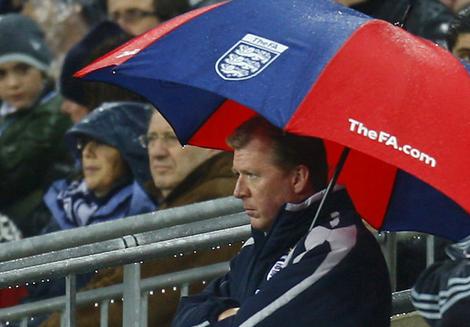
Now, it’s not like these international fixtures are without their pitfalls. And principally I’m referring here to their propensity to draw the underbelly of English society out in their droves – the Gazzas, Bazzas and (in honour of Rooney, King of the Chavs) Wazzas, swigging Carling from tins, and chanting obnoxious profanities through the national anthem of England’s opponents. (Although this jingoistic loutishness should not be seen as being confined to England – when Egypt beat Algeria in a recent football match, a mob of angry Algerians rampaged through the streets of Algiers, vandalising the properties of Egyptian businesses in the city. Gazza, Bazza and Wazza are models of sobriety, decorum and civility by comparison). And there’s also the problem of England’s perennial underachievement on the football pitch. (Although in the spirit of the previous piece on relegation, I suppose I should be grateful for McLaren’s brolly-wielding antics, because when England do finally get their act together, it will make the success even sweeter).

But whatever their drawbacks, these matches give everyone in the country an opportunity to root for the same team.

And I think it’s a “good thing”.

And of course, it’s the same for other countries as well. I was in Malaga when Spain won the European Championships a couple of years ago, and the whole town erupted in the most dramatic and terrifying scenes of celebration I have ever witnessed. (It was also about the only time I have ever known Spanish people to outnumber English people in Malaga, which was a pleasant side-effect). The Norwegians like to join the patriotism party too, as this outstanding diatribe attests.

And it’s not just football. Rugby to a lesser extent, as it is a game alien to the vast majority of English people that are not called Humphrey, Hugo or Hubert. But in the last two Ashes series held in England, in the days and weeks leading up to the final match, the entire country has been gripped by a fervently excited spirit of national unity. When people talk about “atmosphere being electric”, I think it normally sounds trite. But it was absolutely true of London in the late summer of 2005, as Freddie Flintoff raised himself to deified status, and the England cricket team triumphed over the Aussies in thrilling, nail-biting style. I genuinely believe that if Gordon Brown had held the recent election in the immediate aftermath of that Ashes series, the national euphoria would have seen him secure a significantly higher number of votes. Thank goodness he didn’t.

I think it’s a shame that the American people are not given similar opportunities to rally around their national teams.

I think the Olympics comes closest. But it only happens once every 4 years; it’s often more about individual than national achievement – my over-riding memory of Beijing will always be Usain Bolt’s 100m, rather than a British gold medal in a particular and obscure model of sailing boat; and I honestly couldn’t tell you what position Great Britain came in the medals table (whereas I could easily rattle off how they finished in the World Cup going back over the last 20 years). Of course, the US also competes in the football World Cup, but until the current quartet of American sports (am I right to count hockey?) is extended to include “soccer”, Messrs. Donovan and Dempsey will never enjoy the same national support accorded to their English equivalents. (In fact, come to think of it, perhaps that’s why Landon was so irked by Becks’ decision to return to Europe, in the hope of reviving his career with the national team). There are also individual sports like tennis and golf, and there are of course plethore [pretentious sic.] of Star-Spangled Banners unfurled every year at Flushing Meadow and Augusta, but again the protagonists are “Andy Roddick” and “Phil Mickelson”, rather than “The United States”. The Ryder Cup is an obvious exception, and I guess a large part of the country unites behind “Team USA” during this long weekend. But imagine this happening about a sport people really care about.

It’s difficult to see how this can be changed really. The idea of Adrian Peterson, Larry Fitzgerald and Peyton Manning taking on Italy at American Football sounds about as evenly-matched a contest as a debate on “The socio-economic ramifications of globalisation” between Bill Clinton and Miss South Carolina. (Or Bill Clinton and George Bush for that matter). And I think it will be many years before “soccer” is elevated to the same popularity status as “football” or basketball. (And I think there is about as much chance of Americans embracing cricket or rugby as there is of South Carolina flummoxing Clinton with a brilliantly-argued, factually-based argument linking deteriorating economic conditions on the Afghanistan-Pakistan border with the resurgence of fundamentalist Islamic terrorism in the early years of the 21st century). I think basketball and baseball are the best bets. So what about a world cup of each sport, every 4 years, in the month after the season ends?

And I expect this last part is ridiculously over-the-top and complete “baloney”, but you only live once: It is a shame, because I have always known the American people to be incredibly warm, welcoming and friendly, but I think the perception of many people in Europe (and other parts of the world?) is that Americans can be “isolationist” at times. You hear statistics that “70% of Americans do not own a passport” (although I think young Americans’ willingness to experience other cultures is increasing all the time); Bush (and Blair) went to war with Iraq without a UN mandate; and…they play different sports to everyone else. I am sure it will take more than a Basketball World Cup for Jean-Pierre, Gunther and Giuseppe to lay aside their differences with Rod, Todd and Barack, and embrace a “new-found spirit of global brotherhood and partnership”, but it might be a start. (Or Jean-Pierre, Gunther and Giuseppe might be so enraged by the magnitude of the margin of their defeat at the hands of the merciless Kobe and Lebron, that they follow in their Algerian cousins’ footsteps, and brick the windows of every McDonald’s restaurant and Gap store in Paris, Berlin and Rome).

Post script:

OK, since I wrote this article, my highly knowledgeable friend
Zack "Mr. Baseball" Turner has pointed out to me that there is, in fact, already a baseball world cup in existence. However:

1. I did not recognise any of the players on any of the rosters - where are the Rodriguez's, the Pujols, the Jeters, the Lincecums?

2. (Perhaps for the above reason) I was in the US during September 2009, when this tournament allegedly took place. But I did not hear one mention of it in the press.

3. A quick search of the BBC website reveals no mention of the 2009 baseball world cup.

Which is to say, I think the point of this blog still stands. The request just changes from "Please start a baseball world cup", to "Please make a baseball cup where big-name stars compete, and that people are aware is happening".

Monday, 19 April 2010

Ups and Downs

When I was 18 I went to Africa on my gap year. I taught at Chengelo School in Zambia for 8 months, and on one occasion, me and a few friends spent a week cycling through the South Luangwa Game Park. It was about the most exciting thing I had ever done (although I have since built an Excel macro that highlights alternate rows of a selected range), and it was also about as close to "roughing it" as I have ever come. We cycled hard through difficult terrain for about 8 hours each day; we camped out every night; I wore the same pair of pants (British) and socks for the entire week; our food was meagre - even on the few nights when Tim "Butterfingers" Brown didn't spill the prized packet of Supernoodles all over the African earth; and on one occasion Matthew almost got eaten by a hippo.

And then, on the last night, we arrived at this place. The owners had children at the school were we were teaching, and incredibly generously allowed all 4 of us to stay there for the night.

This was incredibly generous for at least 2 reasons:

1. A night in the lodge usually costs hundreds of dollars, and

2. No sooner had we arrived, than the aforementioned Mr. Brown launched a savage verbal assault on the family actually paying to stay in the lodge, unfortunately demonstrating that his conversational adroitness matched his manual dexterity:

Nice husband of paying family: "So what do you do Tim?"
Brown: "Well I was studying law at Christ Church, Oxford. But I dropped out as I really hated the course and all the people were horrible. What do you do?"
Nice husband of paying family: "I'm a lawyer."
Brown: "Ah. OK. Where did you study?"
Nice husband of paying family: "Christ Church, Oxford."
All: [Nervous laughter. Sound of cutlery scraping plates.]

Anyway, we arrived at Tafika and took our first showers for a week looking up at the stars. They were hot. (The stars were also hot I suppose, but I was primarily referring to the showers). We feasted as lavishly upon barbecued meat as the malaria-ridden hordes of mosquitos had feasted on our exposed flesh over the preceding week. The bed was the comfiest I had ever slept in. It was paradise.

And the great thing was that the hardship of the previous week made the luxury and comfort even more exquisite.

And it's the same with relegation.

The bottom 3 teams in the "EPL" (grrr...) each year get relegated to the (rather ridiculously-named) Championship; the bottom 4 teams in the Championship get relegated to the (even more moronically-named) 1st division etc. DOwn about 127 levels, until you reach the Ryman Stationers' League, the Unibond Northern Premier League, and the Beazer Homes League.

American sports do not have relegation, and I think it's a flaw in their structure. (And actually, come to think of it, it's another pretty good example of their cushy communism...).

If you're a Bolton fan or a West Brom fan or a Middlesbrough fan in England (and admittedly their total combined fanbase can be counted on the fingers of one finger [sic.]), you spend most weeks with the heartache and frustration of watching your team get outclassed and beaten. You scrap, you struggle, you win the occasional 6-pointer, you sneak a point at the Emirates by performing GBH on Arsenal, and it all comes down to the last day of the season, when you need 6 other teams to lose, and to beat Man United by at least 13 goals at Old Trafford yourselves. And some (most in the case of West Brom) years, you lose, and you go down. And it's misery. But some years, results go in your favour, you pull it out of the bag, against all the odds Akinbiyi is more prolific than my hyperlinking and nets 14 at the Stretford End. And you survive.

And it's fantastic!

It's as good as winning the league. It's probably better, because you haven't been spoiled by success.

Supporting Man United, this feeling is not one that I have experienced much as a fan (although I am also an avid follower of the mighty Barrow AFC, who do their best to compensate in most years).

But the sports teams I play for are, pretty much without exception, about as competent as Parcelforce. My record as King's College Football Captain was:

Played: 9
Won: 0
Drawn: 0
Lost: 9
Scored: 2
Conceded: 54

Needless to say, that year we were relegated (and, to compound the despair, we lost our lucrative deal with the Curry King, when our sponsor realised that we were to sporting excellence as Tiger Woods is to marital fidelity).

But in a thrilling climax to the 2008 season, Old Habs II cricket team - once again despite the shackles of my staggeringly incompetent leadership - conjured a couple of victories from nowhere, benefited from the bankruptcy of a relegation rival, and survived by the narrowest of margins in the (this time more aptly-named) 10th division of the Hertfordshire Cricket League. Honestly, I think it was a better feeling than if we had got promoted.

Here's some reasons why relegation is great:

- It keeps things interesting for unsuccessful teams, right until the last day of the season.

- It gives unsuccessful teams a taste of glory.

- It allows teams in lower divisions to fill the vacated places (i.e. it keeps them hungry and rewards their success).

- And...the hardship (or the threat of hardship) makes the Coppinger's guesthouse even more glorious.

Dear America, Relegation is great. You should try it.

Wednesday, 7 April 2010

Varsity Blues

I'm watching the NCAA Championship Game between Butler and Duke right now. It's half-time and Duke are up by 1 point.

And it's great.

There's a brass band, cheerleaders, 70,000 people in the stadium, and…wait for it…IT'S ON TV!

I know less about basketball than I know about the political system of Burkina Faso, but I know it's exciting (the Championship Game that is, not the Berkinabe government - although I am intrigued as to whether Compaore will stand for a third term in the forthcoming elections). And I'm also learning all the time. Because IT'S ON TV!

College sports in America are awesome.

Beaver Stadium in Pennsylvania holds 107,282 people.

In England, the crowd at even the biggest university football games consists of:
- About 4 or 5 WAGs
- 3 substitutes
- An elderly couple who are down for the weekend to visit their grandson
- The elderly couple's dog (in most games, the dog runs onto the pitch on at least one occasion, and sinks its teeth into the ball, puncturing it. 64% of games are thereupon abandoned, because that is the only ball that either team possesses. The remaining 36% of games are finished by replacing the indentured ball with a collection of plastic bags wrapped up extremely tightly in elastic bands).

Most American college teams are sponsored by Nike.

My college football team was sponsored by the Curry King, which lucrative deal entitled us to free poppadoms on Thursday nights.

American college sports are ON TV!

The closest an English university football match got to televised coverage was when Greg Foot did an episode of Whizz Whizz Bang Bang on ingenious potential uses for recycled plastic bags.

The Boat Race is an exception to the rule. And I do think it would be great if college football had a similar end-of-season competition to the Big Dance…

…But American college sports are to English college sports as Amazon is to Parcelforce.

And did I mention THEY'RE ON TV!

Sunday, 21 March 2010

Fair play

I have only been in the country for a few days, but I get the impression that American people don’t like Communism. Senator McCarthy certainly didn’t. But while the chances of my immediate deportation might be significantly increased by the following statement, I think that one of the best things about American sports is their communism.

Now I’m not talking about Bread Lines and Gulags here, but let’s face it, the idea that the team that wins the Super Bowl gets the last draft pick the following year is pretty anathema to the capitalist ideal. And I love it!

In the “EPL” (an acronym that still nauseates me to the core), if you win the league, you get some prize money, you use this to buy better players, and your chances of winning the league again next year go up.

Now I am a Manchester United fan, but even I see the attraction of a system that prevents one team from winning the league in 11 out of the last 17 seasons. And Manchester United is about the most tolerable example of enduring success in English football in the last decade. By which I mean that Alex Ferguson earned it.

When he arrived at the club in 1986, United were not a dominant force in the English game. Sure they had the legacy of Best and the Busby Babes (at which point, those reading this who understand football as a game of four quarters will probably conjure images of Hungarian hat-wearing honeys), but they hadn’t won the league for 20 years, and had even got relegated to the old second division as recently as 1974. Even the most bitter Liverpool fan would have to concede that Ferguson was incredibly astute in the transfer market in the early 1990s (at least before he temporarily lost his mind with the purchases of Kleberson, Jordi Cruyff, and the one-trick wonder). But he bought Peter Schmeichel, Eric Cantona and Roy Keane – arguably the three most influential players in the history of the Premier League, for the combined sum of £5.5m. That’s the same as Leicester paid for Ade Akinbiyi. Ferguson crafted a title-winning team out of nothing, and it is difficult to argue that United’s unprecedented success over the last 20 years has been undeserved, even if the vast majority of Englishmen have found it unpleasant, and even a Manchester United fan like myself might concede that it has been unexciting – or at least undiverse, which might amount to a similar thing (if you believe in “old adages”. Which I do. Even if only because I think adage is a nice word, and therefore adages must be nice things).

And I would add Arsène Wenger’s Arsenal to this category as well. Wenger made some great signings in his early years at Highbury, and Arsenal’s success during his tenure has also been earned, even if it has been less enduring (he added, smugly).

And then there’s Chelsea. Chelsea basically bought their 2005 title with money supplied by a profiteering Russian oiligarch. Which I find a little depressing. And add Manchester City to this category. If they do ever actually break into the top 4 (he added, even more smugly).

But the point is, whether it is “deserved” or bought, success in English football is self-perpetuating.

By contrast, in American sports, “many that are first shall be last and the last shall be first”. Now of course, there are teams that have enjoyed prolonged periods of success – due to great coaching, great players and great fans. And of course there are the Chicago Cubs.

But the NFL system is set up to mitigate against the concentration of power that characterises English football (and Spanish football, and Italian football, etc.) in at least two ways.

Firstly, the team that comes first in the previous year gets the last draft pick in the next year.

And secondly, the schedules for the teams that win their divisions are tougher in the following year.

I think this keeps things interesting, and is a “good thing”.


The number of teams that have won the English Premiership in the 18 years since its inception in 1992? 4. The number of teams who have won the Super Bowl in the same timeframe? 13. The number of different teams that have finished in the top 4 in England in the last 7 years? 5. The number of teams who have reached the NFC and the AFC Championship games in the same timeframe? 20.

I’ll take the American numbers.